
Puffins are on Skellig Michael from about late April to early August each year. Most are there in May, June and July, so these are the best months to see them. For the rest of the year the Skellig Michael puffins live out at sea.
Thousands of puffins nest on the island, living in burrows on the steep grassy slopes and in gaps between the rocks.
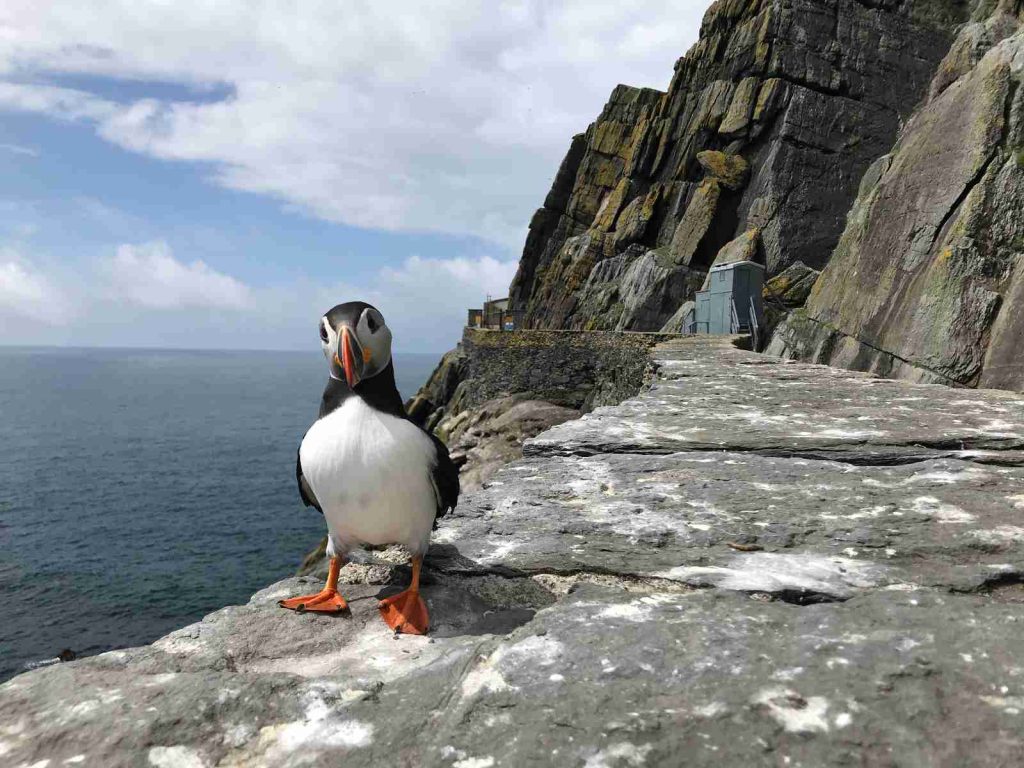
April, the puffins arrive
Puffins spend the winter far out at sea and come back to the waters around the Skelligs in spring.
At first they gather on the sea in large groups called rafts. They spend hours on the water before they fly up to the slopes.
By late April they are coming ashore, and most go back to the same burrow they used the year before.
Puffins usually keep the same partner, and when a pair meets again at the burrow the two birds rub their beaks together. This is called billing, and it helps the pair bond.
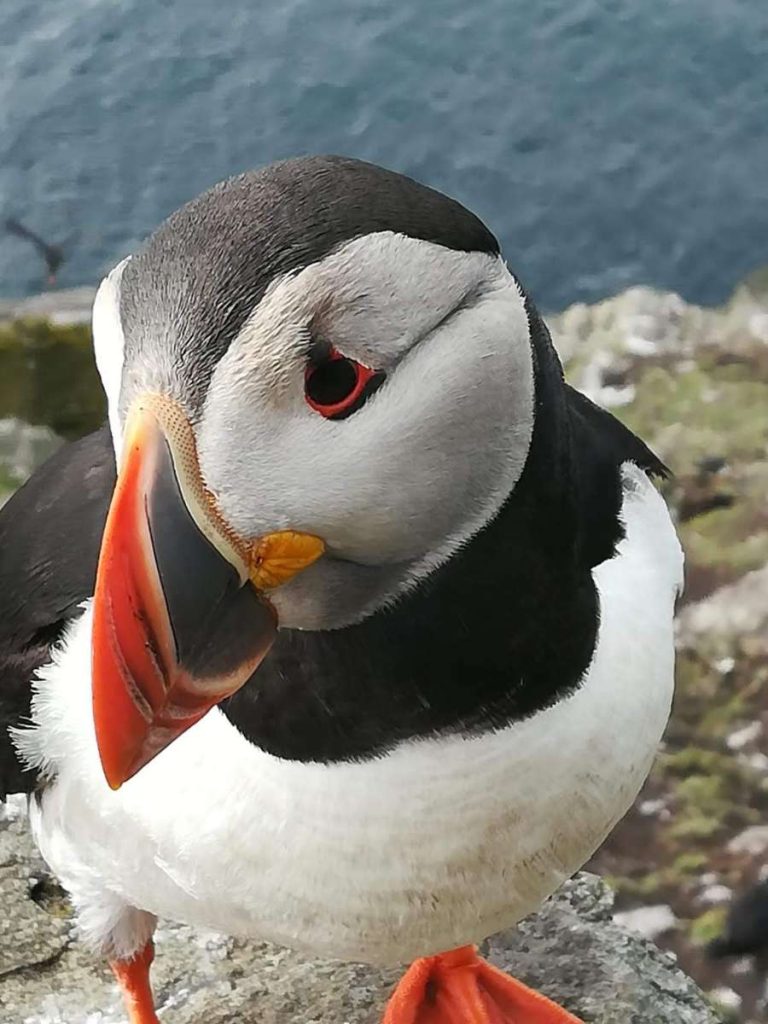
Their beaks change in spring too. Over the winter the beak is smaller and dull, but before the birds come ashore it grows bigger and turns orange, blue and red. The bright colours help them find a mate.
May, digging burrows and laying eggs
By May the colony is settled and the puffins get their nests ready on the lower and middle slopes, where the soil is deep.
They dig new tunnels with their sharp claws or clear out old ones that may once have been used by Manx shearwaters or rabbits. Their strong orange legs are set far back on the body, which helps them dig.
Each pair lays just one egg in May. Both parents share the work and take turns to keep the egg warm under one wing for about 39 to 45 days.
One parent stays in the burrow with the egg while the other goes fishing. This keeps the egg safe from great black-backed gulls, which hunt over the islands.
May is a quieter month in the colony, and from the boat you can often see puffins standing outside their burrows.
June and July, feeding the chicks
The eggs hatch in June. For the next five to six weeks the parents fly back and forth with food for the puffin chick, which is often called a puffling. This is the busiest time of year in the colony.
Puffins feed their chicks on sand eels, which are small thin fish. A puffin can carry a dozen or more in its beak at once. Small ridges inside the beak and the tongue hold the fish in place while it catches more.
The puffins fly in fast with their beaks full of fish, while gulls and skuas chase them and try to steal their catch.
On the landing tour, the path up to the monastery passes close to the burrows. Puffins often rest on the stone steps and the old monastery walls.
August, the chicks leave
As the chicks grow, the parents bring food less often. The chicks leave the island at night, mostly in the first two weeks of August. Leaving in the dark keeps them safer from gulls as they make their way down the slopes to the sea and swim away.
A young puffin stays at sea for several years and only comes back to land when it is ready to breed.
The adults leave within a few days of the chicks, and by mid-August there are very few puffins left on the island.
September to March, the winter at sea
Puffins spend the winter alone on the open sea, spread out across the North Atlantic instead of living in colonies.
In late summer they lose the bright plates on their beaks and the coloured patches around their eyes, so their winter look is much plainer.
Tracking has shown that Skellig Michael puffins travel widely in winter. Some stay in the Celtic Sea or go south towards the Bay of Biscay, while others cross the Atlantic as far as Newfoundland.
Storms and a lack of food in winter can kill adult birds. Each pair raises only one chick a year, so the colony is slow to recover from these losses.
Looking after the colony
The Atlantic puffin is listed as a vulnerable species. Changes in sea temperature can move the sand eels, so the puffins have to fly further for food, which can mean fewer chicks survive.
Puffin burrows are easy to crush, so if you land on Skellig Michael, stay on the marked paths to avoid collapsing them.
How to see the Skellig Michael puffins on our tours
All our tours leave from Portmagee, and the best chance of seeing puffins is in May, June or July. Sightings are never guaranteed, and every trip depends on the sea.
From the boat
Our Skellig Islands boat tour circles Skellig Michael and Little Skellig without landing, takes about 2.5 to 3 hours and suits all ages.
In puffin season you can see the birds on the water and outside their burrows on the slopes. You also pass Little Skellig, which has one of the biggest gannet colonies in the world.
On the island
On our Skellig Michael landing tour you have about 2.5 hours on the island. You climb 618 stone steps to the monastery, and the path passes close to the burrows.
The landing tour runs from mid-May to the end of September and is for ages 14 and over. The Office of Public Works limits how many people can land each day, so book early. Landing is never guaranteed because it depends on the sea.
Puffin Island
Puffins also nest on Puffin Island from April to August, and we run a Puffin Island and Kerry Cliffs tour from Portmagee.
For the other seabirds you might see, read our guide to the birds of the Skellig Islands. To choose your dates, see the best time to visit Skellig Michael.