
When the credits rolled on The Force Awakens in 2015, the world was introduced to the planet Ahch-To, the remote ocean world where Luke Skywalker had been hiding in self-imposed exile. For Star Wars fans, it was a mysterious, ancient, and otherworldly location. For those of us here in County Kerry, we recognised it immediately as our very own Skellig Michael.
Since the release of the sequel trilogy, we have had plenty of visitors boarding our boats at Portmagee Marina asking the same question: "Is this place actually real, or is it mostly CGI?" It is a fair question. The island looks so dramatic and prehistoric that it feels like it belongs in a galaxy far, far away. However, the truth is that almost everything you see on screen is 100% real Irish history.
The Jedi Temple vs. The 6th-Century Monastery
In the Star Wars universe, Skellig Michael serves as the site of the first Jedi Temple. The film shows Rey wandering through a cluster of stone huts where she seeks out the wisdom of the last Jedi Master. While the "Jedi" part might be a bit of Hollywood magic, the huts themselves are entirely authentic.
These structures are known as clocháns, or beehive huts. They were built by Christian monks who arrived on the island as early as the 6th century. These monks sought a life of extreme solitude and penance, choosing to live on a jagged rock jutting out of the Atlantic Ocean, 12 kilometres from the mainland.
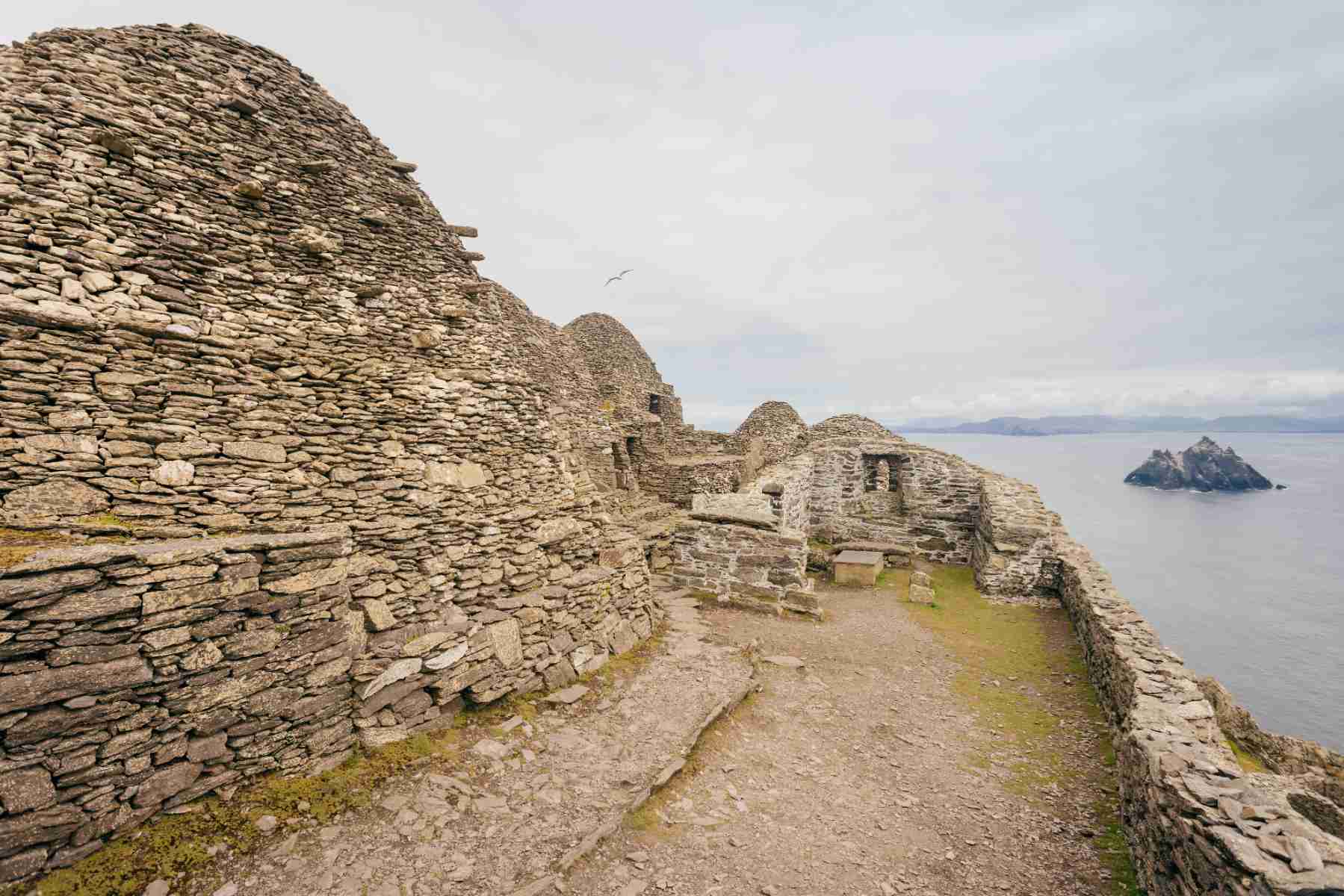
The monks built these huts using a technique called dry stone corbelling. This means they stacked stones on top of each other without a single drop of mortar or cement. They were angled slightly outward to ensure that the relentless Atlantic rain would run off the sides rather than soaking through. Over 1,400 years later, these structures still stand exactly as the monks left them. When you walk through the monastic village today, you aren't walking through a movie set; you are walking through a UNESCO World Heritage site that has survived centuries of storms and Viking raids.
The Ascent: 618 Steps to Enlightenment
One of the most iconic parts of the films is the long, arduous climb that Rey takes to find Luke at the summit. In The Force Awakens, we see her navigating a steep, winding stone staircase that seems to lead directly into the clouds.
In reality, these steps are the primary way to navigate the island. There are over 600 stone steps leading from the landing point up to the monastery. They were hand-carved into the rock by the monks over a millennium ago. For the film crew, this was one of the biggest logistical challenges. Every camera, every prop, and even Mark Hamill and Daisy Ridley had to make that climb.
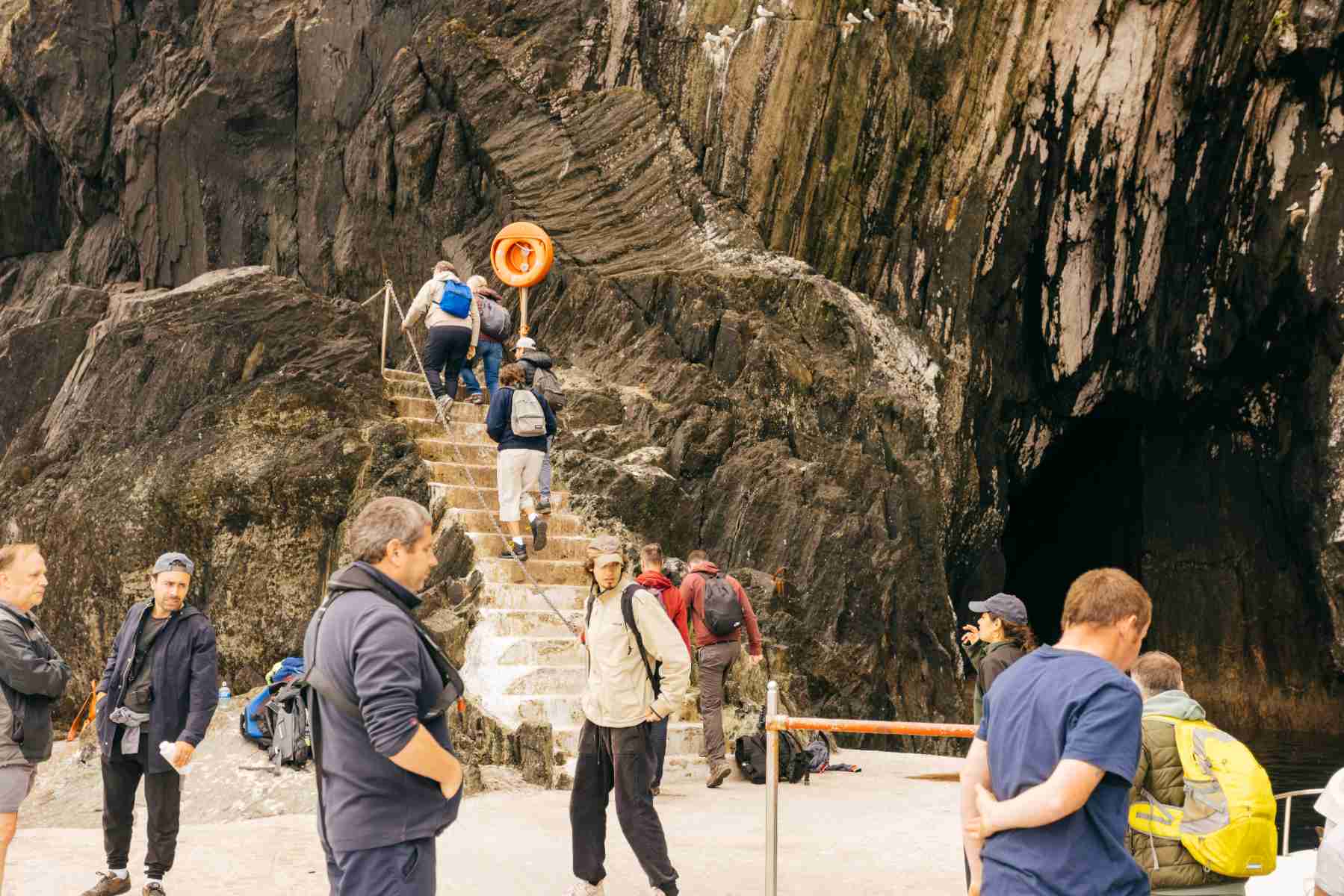
One specific location fans often ask about is the "Wailing Woman." In the film, this is the narrow, dramatic ridge where Rey practices her lightsaber skills. In reality, this is part of the path near the South Peak. While the lightsaber was added in post-production, the sheer drop and the breathtaking view behind her are completely real. It is a precipitous and arduous climb, and while the monks did it daily for centuries, modern visitors are always reminded of the gravity and scale of the site. Safety is paramount, and the steps are a non-negotiable mandate for physical fitness.
The Porgs: An Accidental Creation
Perhaps the most famous inhabitants of Ahch-To are the Porgs: those wide-eyed, winged creatures that nested in Luke’s X-Wing. While they look like something dreamt up in a creature shop, their existence was actually a practical solution to a very "real world" problem.
Skellig Michael is a protected sanctuary for thousands of Atlantic Puffins. During the summer months, the island is literally covered in them. When the crew arrived to film The Last Jedi, they realised it would be impossible to keep the puffins out of the shots. They were everywhere: on the steps, on the huts, and flying through the background of every take.
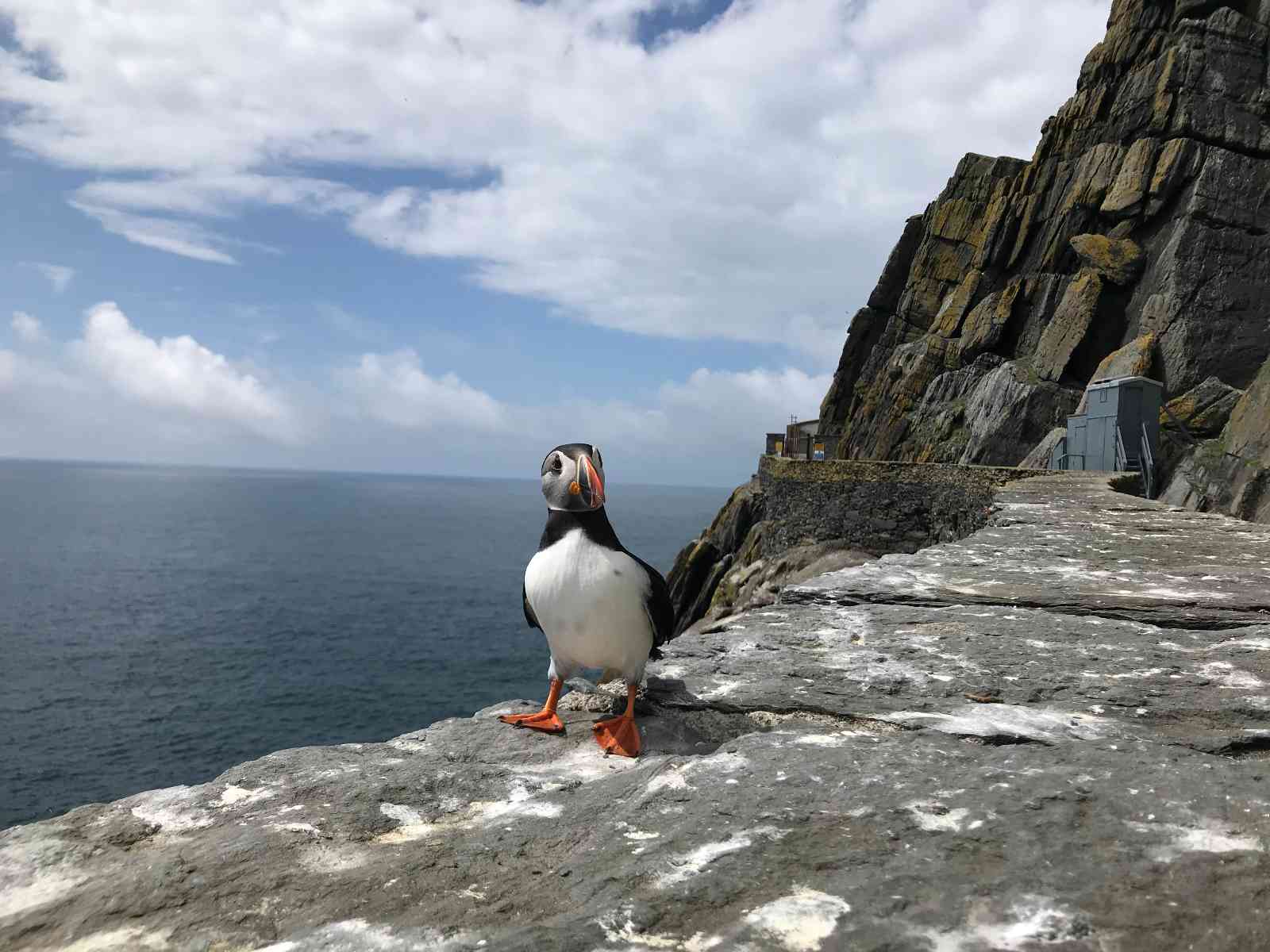
Rather than spending millions of dollars digitally removing every single puffin from the footage, the production team decided to lean into it. They used the puffins as inspiration and created the Porgs to "mask" the real birds. So, every time you see a Porg on screen, you are actually looking at a digital stand-in for a real Skellig Michael resident. If you visit us between May and July, you won't see any Porgs, but you will see thousands of their real-life counterparts nesting right next to the paths.
Where Reality Meets the Green Screen
While Skellig Michael provided the soul of the film's location, it wasn't the only place used. Because the island is a UNESCO World Heritage site, there are strict rules regarding how much filming can take place. Conservation and "Leave No Trace" principles are at the heart of how the island is managed.
To protect the delicate structures and the local wildlife, the film crew was only authorised to film on the island for a limited number of days. This meant that while the wide establishing shots and the iconic monastery scenes were filmed on Skellig Michael, many of the close-up dialogue scenes between Luke and Rey were actually filmed elsewhere.
The production team built replicas of the beehive huts at Malin Head in County Donegal and on the Dingle Peninsula. This allowed them to film late into the night and use heavy equipment that would have been too dangerous or damaging to bring onto the real island. However, the atmosphere of those scenes was entirely dictated by the time they spent on the Skelligs. The misty, rugged, and isolated feel of the island is something that simply cannot be faked in a studio.
The Real History is More Incredible Than Fiction
As much as we love the Star Wars connection, the real history of Skellig Michael is arguably even more impressive than a space opera. The monks who lived here weren't just seeking a quiet place to meditate; they were survivalists. They lived on a diet of fish, seabirds, and whatever vegetables they could grow in tiny, hand-built terrace gardens. They survived Viking attacks in the 9th century and eventually moved to the mainland when the climate became too harsh in the 13th century.
The island is a testament to human endurance and spiritual devotion. When you step off the boat and look up at the towering peaks, you feel the weight of that history. The Star Wars films brought global fame to this corner of Ireland, but the island’s significance was established long before George Lucas ever dreamt of a Jedi.
See the Reality for Yourself
If you want to experience the "real" Ahch-To, there is no substitute for being there in person. At Skellig Michael Island Tours, we take pride in showing visitors the bridge between the cinematic world and the historical reality.
Our tours depart daily from Portmagee Marina, assuming the Atlantic weather behaves itself. Whether you are a die-hard Star Wars fan looking for Luke’s hideout or a history buff wanting to see the ancient clocháns, the journey across the water is an unparalleled experience.

Because of the island's protected status and its popularity, we always recommend booking well in advance. Head straight to our contact page to start planning your adventure.
The Force might be fictional, but the magic of Skellig Michael is very, very real. We look forward to welcoming you aboard and showing you the edge of the world.